Should you buy your workplace sensors outright (Capex) or pay for them as an ongoing service (Opex)? The choice affects your cash flow, your budget for years to come, and how easily your sensor setup can keep up with your organization. Here’s how the two models compare, and which factors should decide it for you.
What are Capex and Opex?
Capital expenditure (Capex) is an investment in long-term assets, such as equipment, machinery or technology, that create value over an extended period. The cost is paid upfront and depreciated over the asset’s lifetime.
Operational expenditure (Opex) covers the ongoing, day-to-day costs of running a business, usually paid on a recurring basis. For workplace sensors, Opex typically takes the form of an as-a-service model: you pay a subscription that covers the sensors, connectivity and dashboard.
Capex: buying your sensors
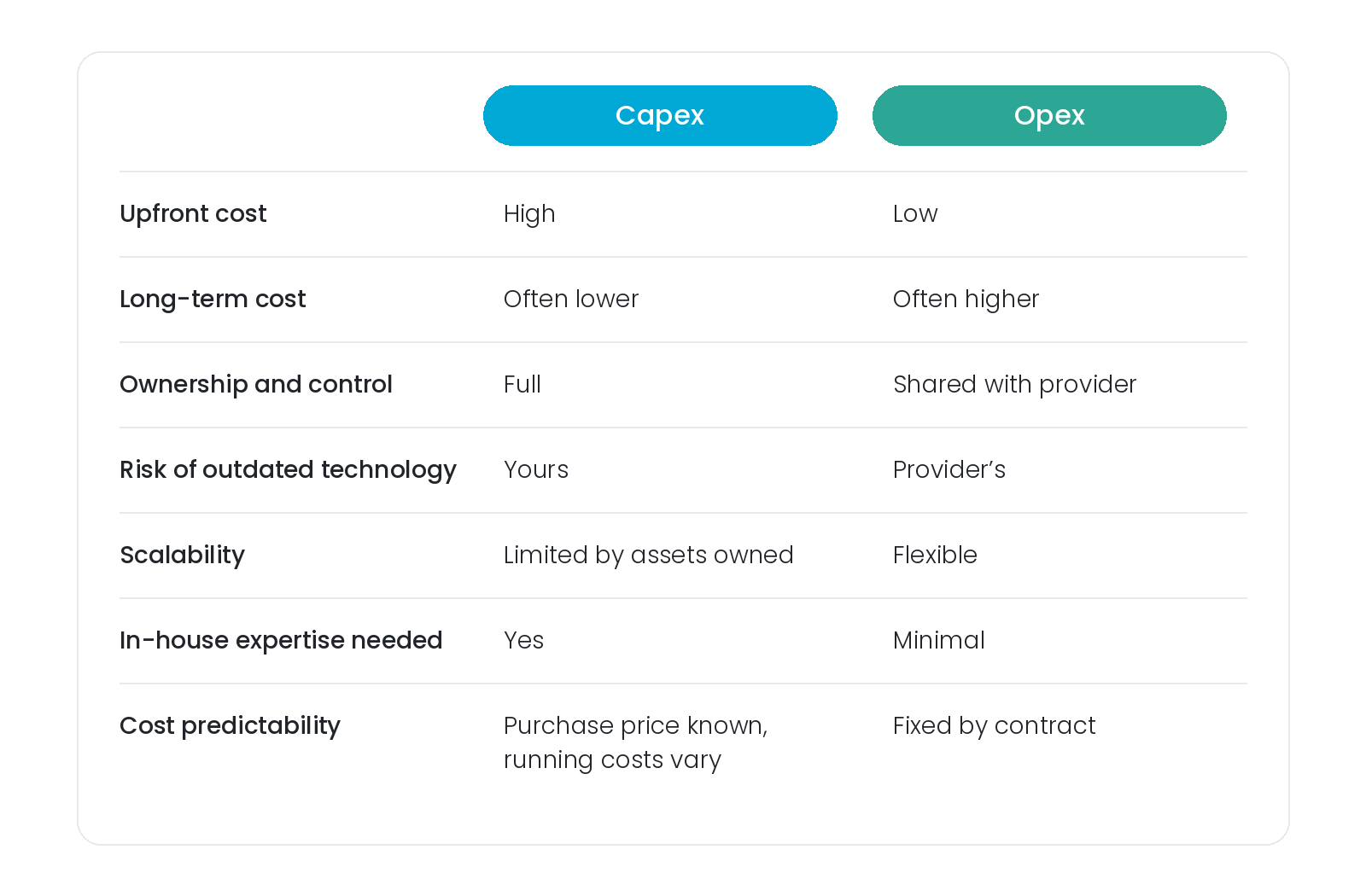
Ownership and control
Buying sensors outright means you own and control the technology. That control comes with responsibility, though. You need someone in-house who can manage the sensors, their connections and the dashboard, and turn the data into the insights you need.
There’s also the risk of obsolescence. Sensor technology evolves quickly, and hardware or software you buy today may become outdated sooner than expected.
Costs
The biggest drawback is the upfront cost. Equipping every desk and room with sensors requires a substantial investment, which can strain cash flow.
On the other hand, the purchase price is known in advance and can be budgeted for, which suits organizations with stable, predictable space needs. Keep in mind that the purchase price isn’t the whole picture: maintenance, battery replacement, software licenses and the staff time to manage it all add to the real cost.
Opex: sensors as a service
Access to the latest technology
With an as-a-service model, the provider is responsible for keeping the technology current, which reduces the risk of obsolescence. Scaling is also easier: you can add or remove sensors as your office changes, without committing to a fixed set of assets.
The trade-off is control. You depend on a third-party provider and its service levels, so the contract and the provider’s track record matter.
Costs
Opex keeps upfront costs low, which makes sensor technology accessible to organizations with limited capital to spend. A clear service contract also gives you predictable monthly or annual costs.
Over the long term, however, subscription fees add up, and the total cost of ownership can end up higher than buying outright.
How to choose between Capex and Opex
The right choice depends on your goals, financial position and operational needs. Weigh these factors:
- Business strategy: is workplace data central to how you run your real estate, or a supporting function?
- Financial resources: can your cash flow absorb a large upfront investment?
- In-house expertise: do you have people who can install, manage and interpret a sensor system?
- Scalability: do you expect your headcount, office footprint or sensor needs to change significantly?
- Technology lifecycle: how quickly is the technology you need likely to change?
Tax treatment differs between the two models as well, so involve your finance team early.
There’s no one-size-fits-all answer
Capex gives you ownership and a potentially lower long-term cost. Opex gives you flexibility, current technology and a lower barrier to entry. The best fit depends on your organization’s circumstances, and some organizations combine both, buying core infrastructure and subscribing to the software and analytics.