Bol.com started in 1999 as an online bookshop with seven employees, working from a portacabin in a parking lot in Utrecht. The company later rebuilt that portacabin and placed it in a museum inside its head office.
By 2019, that head office on the Papendorpsweg in Utrecht had 2,200 workplaces for 2,600 employees, spread across four office towers: B, C, E and F.
Bol.com was growing every year. To use its existing offices more effectively while it prepared for further expansion, the company worked with real estate advisor JLL and with Measuremen, which began measuring workplace occupancy across the building in early 2019.
The challenge: accommodating rapid growth in the existing building
Bol.com was hiring around 300 new employees a year, and in some periods as many as 100 people a month. The company also welcomed a large group of interns twice a year, and it expected this growth to continue.
Bol.com first considered other locations, but in May 2019 it decided to expand at its current site instead. A new tower (A) was planned for 2021, adding 6,700 square meters of lettable floor area and 570 workplaces, with Tower D offering room for further growth. Until the new space was ready, the existing buildings had to accommodate every new hire.
Dorine van Ierschot, Senior Workplace Management Specialist at Bol.com, is responsible for the company’s strategic accommodation. She joined Bol.com in 2014 as a contract manager, the same year the company moved from the Keulsekade to the Papendorpsweg. She described the main question: “For how long can we continue with the current number of square meters, and what can we do to make that possible?”
JLL had supported Bol.com since its first move and guided the company into its third office building. It now helped Bol.com understand its capacity. Each team needed specific spaces and tools, and many teams worked closely together, so Bol.com needed to know what each team required and where to place it in the building.
Other factors added to the pressure. Employees thought differently about work than they used to, and working from home had become an option. At the same time, Bol.com wanted to protect the quality of its work environment, which Van Ierschot saw as the biggest challenge of the years ahead.
“Employees and the business should not notice what we are doing behind the scenes when it comes to housing. The working environment at Bol.com has always had a certain dynamic, and we want to maintain it. We also want it to remain safe and pleasant.”
Dorine van Ierschot, Senior Workplace Management Specialist, Bol.com
Protecting the work environment
That environment covers more than desks. With an average employee age of 35 at the time, Bol.com paid close attention to work-life balance and vitality. “We work hard, but there is also time for fun and vitality,” says Van Ierschot. The company offered gym and boxing classes, yoga, boot camp and in-house physiotherapy, ran projects on drinking water, and invited speakers to talk about the importance of sleep.
During “Steptember,” for example, employees received Fitbits and competed in teams to take the most steps. Employees valued the chance to exercise during working hours, so they were done by the time they left the building.
Travel mattered too. Bol.com measures employee satisfaction regularly, and travel time came up as a key topic. The head office sits in a business park far from the train station, and most employees came from Utrecht, with a smaller group from Amsterdam. To encourage public transport for sustainability reasons, Bol.com ran shuttle buses to and from the station during rush hour. “We notice that this encourages employees to use public transport, because it makes travel easier and more pleasant,” Van Ierschot says.
Bringing workplace management into HR
Bol.com also changed how it organized this work. The company renamed its Facility Management department to Workplace Management and moved it into HR, which Bol.com calls People&. “We made that change because we noticed that, as an organization, we made many choices from an HR perspective,” Van Ierschot explains. The department also works closely with IT, since many projects and decisions involve People&, IT and Workplace Management together.
To make the right housing decisions, Bol.com needed a clear picture of where crowding occurred and which teams it affected. It had never used workplace occupancy data to answer these questions before.
The solution: quarterly workplace occupancy studies
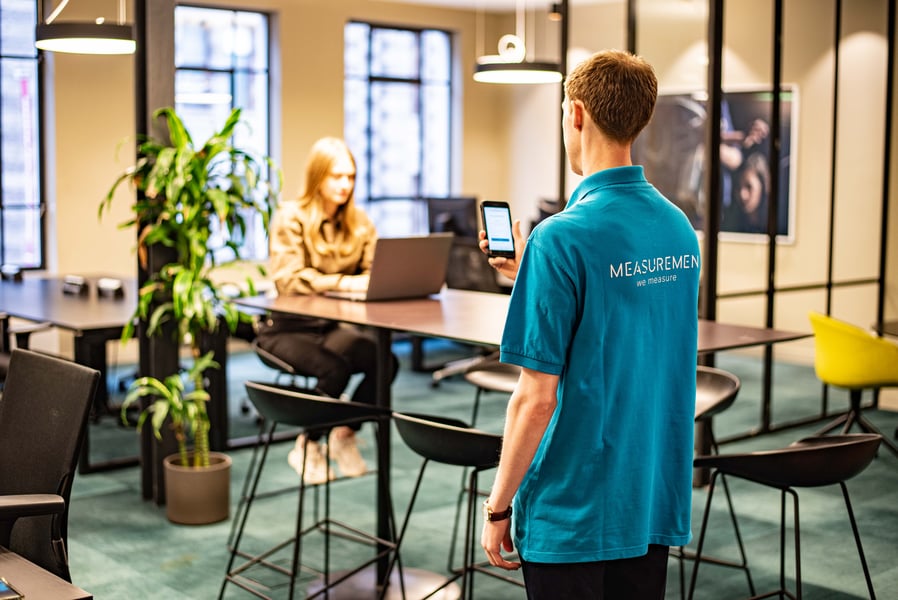
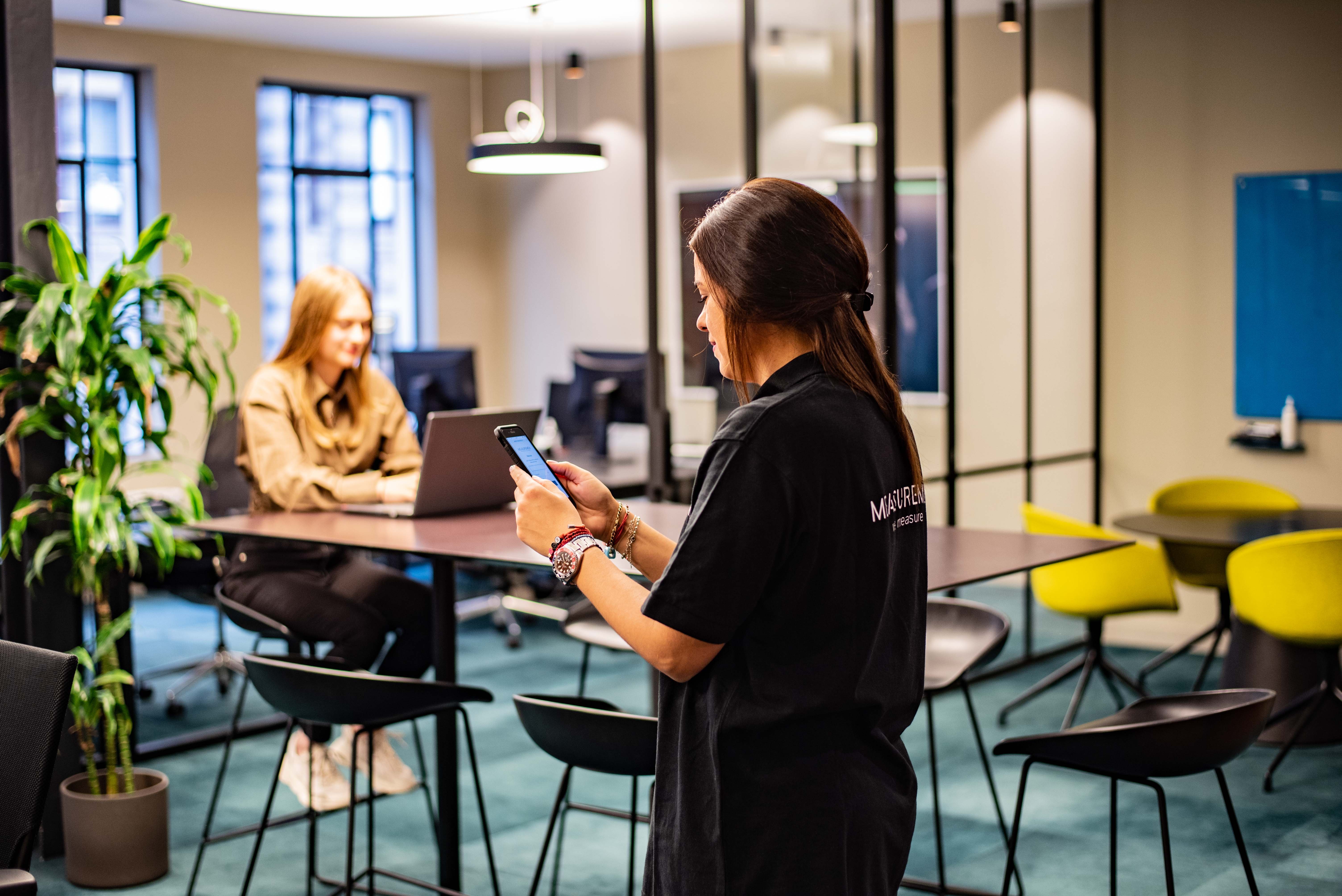
From the start of 2019, Measuremen carried out quarterly workplace occupancy studies at Bol.com. Each quarter, Measuremen’s observers walked through the building for two weeks and recorded how one floor was used.
“This way, we can identify where crowding is a problem, on which floor and in which team,” says Van Ierschot. “Together with JLL, we then look for solutions to keep the office safe and pleasant. We also look closely at issues such as acoustics and indoor climate.”
The measurements served as a baseline, which Bol.com and JLL used to decide how to measure in the next stage and which tools fit best. It was the first time Bol.com had worked with this type of data. “The information is very valuable for us,” Van Ierschot says. “It tells us about workplace occupancy, but also about our meeting culture.”
JLL used the data to shape its housing advice. Owen Zachariasse of JLL explains why the company takes the time to build thorough advice: “JLL has always aimed to provide exceptional service to its clients. Our ability to generate, analyze, and deliver specific, valuable advice based on data allows us to serve our clients more effectively than ever before. At the same time, people are at the center of JLL. We are committed to creating strong work environments for people, teams, and organizations, and quantitative and qualitative data analysis helps us do exactly that.”
The results: a data-backed housing strategy and the Cosy project
The occupancy data shaped decisions in both the short and long term. For the long term, it supported Bol.com’s housing strategy, and JLL presented its accommodation advice to Bol.com at the end of November 2019.
For the short term, Bol.com launched the Cosy project in the fall of 2019. Cosy covered everything the company needed to keep working in its current building, including workplace research, additional facilities and new ways of working.
Under Cosy, employees choose where to sit based on their schedule. “If you have many meetings, you don’t need a fixed workplace that day,” Van Ierschot explains. “It is better to put your things in a locker and work at landing places between meetings.” She notes that this approach suits some departments, such as Legal and Finance, less well.
Using workplaces more effectively also required a change in mindset. Cosy asked employees to keep pens, paper and phones off their desks and not to leave coats on chairs. These “signs of life” stop colleagues from using a desk that is actually free. Employees also consider their tasks for the day when they choose a workplace.
Bol.com and JLL also looked at the building itself. Areas such as the atrium and the restaurant weren’t using their space well, so the restaurant was redesigned to serve as a meeting space outside lunch hours.
The project name reflects what Bol.com wanted to protect. “Coziness has always been in Bol.com’s DNA,” says Van Ierschot, “and we want to keep it that way.”
Any housing advice had to stay flexible, because growth was hard to forecast. As Van Ierschot put it, “The growth cannot be predicted for the next five years. We are happy if we can do it for one year.” Beyond Utrecht, Bol.com was building its second distribution center in Waalwijk and rebuilding a smaller one in Nieuwegein for large items, such as washing machines, that cannot run on the conveyor belt. It also has an office in Antwerp to serve customers in Flanders.
With a clear occupancy baseline in place, Bol.com could plan each step of its growth on evidence, one year at a time.